
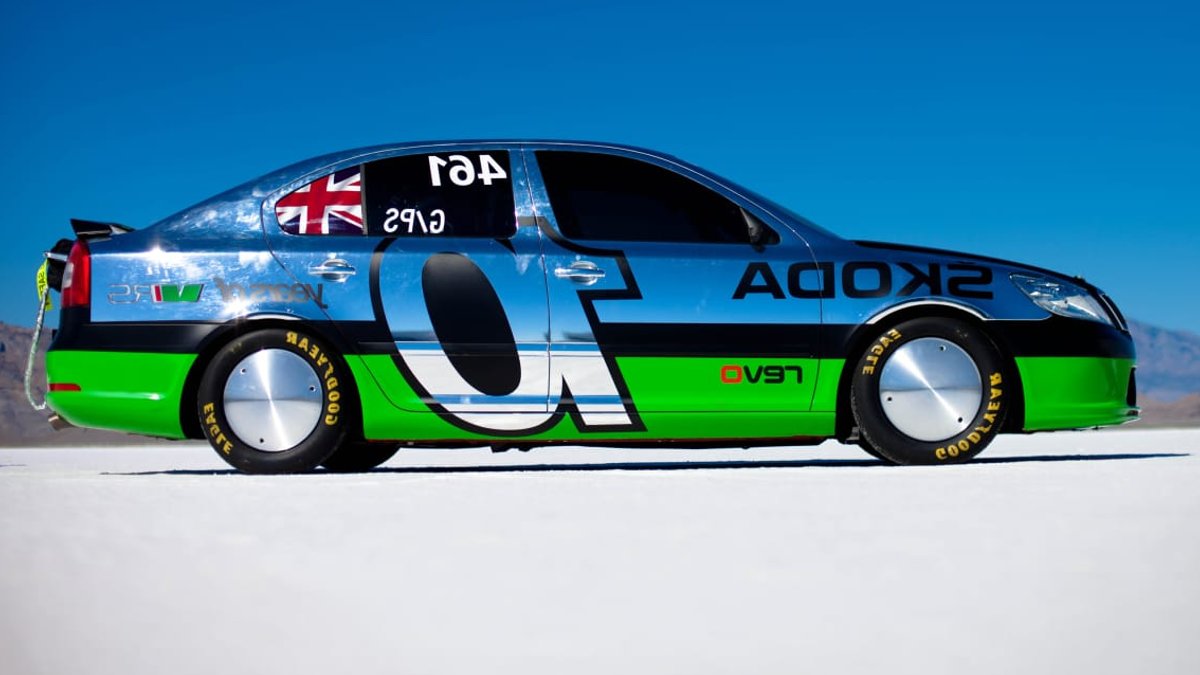
It’s been 15 years since Richard Meaden and Skoda set the production car class top speed record at the Bonneville Salt Flats. The team achieved a record-breaking speed of 227mph in a modified Skoda Octavia vRS. This feat still stands today, with the Octavia vRS holding the title of fastest production-bodied 2-litre car to cross a stretch of the iconic salt flats.
The record attempt was made possible by a team of skilled technicians, including Andy Orme and Ricky Elder from Skoda UK, who stripped and rebuilt a regular production car into a salt-spec vRS saloon. Revo Technik’s Nick Kasberger provided engine tuning know-how, and other specialists contributed to the project.
The Car’s Modifications
The 2.0-litre TSI engine retained its standard block, pistons, valves, cams, crankshaft, head gasket, coil packs, and ECU. However, the factory conrods were replaced with items from Integrated Engineering, and the turbo was upgraded to a Garrett GT3562R. The intake, exhaust, and cooling systems were also modified, and the vRS transmission was swapped for the longer-striding ‘box from an Octavia Greenline.
Related: Alpina B8 Gran Coupe Unveiled Hits 201mph
The car’s chassis was lowered by 80mm on adjustable dampers, and the regular wheels and tyres were replaced with skinny spacesaver-style rims fitted with bespoke Goodyear Eagle Bonneville tyres. The front discs were removed, as braking is not necessary on the salt, and a Simpson parachute was mounted on the rear of the car to slow it down after each run.
The Record Attempt
The team spent six weeks preparing for the record attempt, including a trans-Atlantic voyage and a dyno session in Salt Lake City. Meaden met with the team and saw the car for the first time since the shakedown at Bruntingthorpe. The car underwent a series of safety and eligibility checks, including a “bale-out” procedure, where the driver had to prove they could pull the parachute, hit the extinguishers, and operate the master switch, ignition, and fuel pump switches, then extricate themselves from the car quickly.
The team made their first 200mph attempt on Monday afternoon. The car’s standard ECU and ignition coil packs were close to their limit, but Nick Kasberger was able to coax more power from the engine by being creative with the software. Despite some issues with the fuelling, the car managed to reach 202.15mph, and the team was confident they could go even faster.
Related: Royal Enfield Himalayan road test review
After a series of runs, the team made their final attempt on Thursday afternoon. The car was tweaked to produce almost 600bhp at the wheels, and Meaden was able to reach a peak average speed of 228.642mph. When averaged with the previous day’s run, the team achieved a new G/PS class record of 227.08mph.
This record attempt was a significant achievement, especially considering the team’s lack of experience at Bonneville. The success of the project is a sign to the skill and dedication of the team involved. In the context of other land speed records, this achievement is particularly notable, as it demonstrates the potential for production-based cars to reach high speeds with careful modification and tuning.
The Aftermath
The team’s achievement was met with a mix of relief, disbelief, and euphoria. The experience of driving at such high speeds on the salt is unique and exhilarating. The lack of grip and the ever-present risk of crashing make it a truly challenging and intimidating environment. However, with the right car and the right team, it is possible to achieve great things, as Meaden and Skoda proved 15 years ago.


