
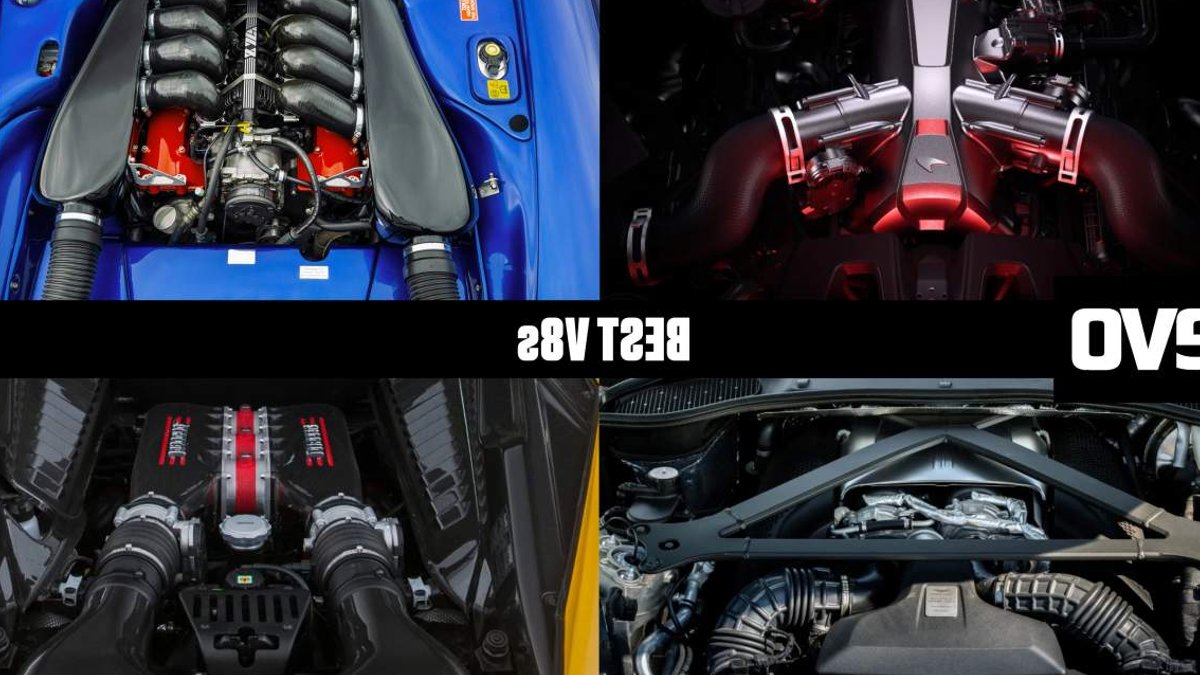
Best V8 cars ever – from high-revving Ferraris to burbling TVRs
The V8 represents the most versatile performance car engine configuration, powering everything from exotic supercars to pickups. These selections represent our favorites. Before downsizing, electrification and mass-turbocharging, the easiest way to make big power was adding displacement and cylinders. The V8 became the ideal format for performance that could be exotic enough to power supercars, but cheap enough to power everything from pick-up trucks to sports saloons.
America’s pushrod legacy
There is probably more variety of engines that can be described as a V8, compared to any other layout and cylinder count. What exactly can the engines in a Ferrari 458 Speciale and a Ford F150 say they have in common, beyond cylinder counts? That, along with the fact that almost all of them have their charms – be that prodigious performance, a great sound or both – makes listing the best V8s an interesting challenge.
By best we mean our favourites, because if we are talking about objective performance-based scoring, then the slightly numb BMW M twin-turbo V8 vastly out-ranks the howling naturally-aspirated 4-litre the marque only installed in the E9X-generation M3. And that would be criminal.
Equally, a plodding Ford Flathead from the ‘50s isn’t exactly up to modern standards, important to the history of the V8 though it is. The publication is also only covering road-going V8s strictly speaking, but Cosworth’s DFV deserves at least a mention here. So, this is a selection of V8s – and the best car they power – that best speak to The Thrill of Driving. The V8s that deliver it all. Power, yes, but also personality.
GM LS7 – Chevrolet Camaro Z/28
It would not be a list of V8s without the iconic General Motors LS. And the best of them all? The naturally aspirated, 427 cubic inch (or 7-litre to you and I) LS7, as was used sparingly throughout the GM range over a relatively short period. It is part of the same iconic Chevrolet small-block engine family, and as such does without overhead cams, instead relying on pushrods, which although somewhat archaic, save on both space and complexity.
Related: Skoda Octavia vRS hits 227mph at Bonneville
It might not seem cutting edge, but the LS7’s magic lies in its size, feeling effortless and yet still happy to rev with reasonable alacrity. It was first found in the C6 Corvette Z06, and later in the brilliant Camaro Z/28.
The British connection
You cannot talk about V8s without a true British great (that was first American) – the Rover V8. Quite unlike the freshly-hewn Corvette engine above, the Rover V8 was built from the bones of an all-alloy engine that General Motors abandoned in the early 1960s. It went on to serve in Rovers, Range Rovers, TVRs, Triumphs and so much more, all the way into the mid-2000s.
Why did GM abandon it? Well, it was expensive to build and proved a bit too unreliable, but J. Bruce McWilliams of Rover saw its potential, buying up the rights and adapting it for first use in the Rover P5. The rest is history, with the likes of TVR and Marcos stretching it beyond all recognition for high-performance use, the Griffith utilising a 5-litre, 340bhp version of the engine with a 90mm stroke. Rover V8s, especially in TVRs, are beloved for their fulsome torque offering and burbling soundtrack.
Antiquity eventually caught up with the Rover V8, its low efficiency and relatively low output impressive by the standards of DOHC engines that were appearing on the European scene in the late 1990s and early 2000s. Chevrolet still managed to make a pushrod V8 work in terms of power, performance and fuel use, though. Could the Rover mill have been re-engineered to live a longer life of its own? Maybe, though doing so would surely have expedited MG-Rover’s circling of the pan.
Flat-plane speed
TVR AJP – TVR Cerbera
TVR did not always rely on external help for its engine supply, as it created its very own in-house unit with the ‘AJP’. This found its way into the heart of the iconic Cerbera, first in 4.2-litre form but later in a higher-revving 4.5-litre variant found in the Mk2 ‘Red Rose’ car we drove in evo issue 349.
Power stands at a punchy 440bhp and 402lb ft of torque in this form with to the aforementioned upgrade package, and a low 1100kg kerb weight makes it feel those numbers and more. ‘When the V8 fires, it sounds like a ground-level sonic boom. You can’t sneak under the radar in a Cerbera. It sounds even better on the move, sound waves ricocheting off County Durham’s dry-stone walls. Throttle response is fantastically crisp and sharp…’ – James Taylor, evo issue 349
It is interesting to compare the AJP to the Porsche M1800 found in the 918 Spyder. Both engines are built for high-revving thrills, yet they come from very different engineering philosophies. The AJP relies on a single camshaft and a flat-plane crank to create its aggressive sound, while Porsche’s M1800 uses dual overhead cams and a chain drive to rev to 9200rpm. Despite the differences in construction, the result is the same: a mechanical soundtrack that is distinct and unmistakable.
Related: Alpina B4 Bi-Turbo Convertible beats BMW M4
The European super V8
Mercedes M159 – Mercedes-Benz SLS AMG Black Series
We could not have compiled this list without mention of an AMG V8, and it’s the M159 that was arguably the finest of them all. Noted for its large capacity – all 6208cc of it – the M159 yielded big torque numbers, but unlike most engines of its size still relished revs. Although it was closely related to more mainstream AMG V8s used in the C63 and E63, the M159 was bespoke to the SLS, dry-sumped, and in SLS Black Series form revved to an 8000rpm red line, some 800rpm higher than in the standard SLS.
It also featured a bespoke valvetrain, intake, headers and exhaust compared to the M156, and in the Black Series was the most powerful naturally aspirated engine up to that point regardless of cylinder count. And what does 6208 cubic centimetres of swept capacity sound like at 8000rpm? Like almost nothing else.
The modern benchmark
GM LT6 – C8 Corvette Z06
The brief must have been relatively simple for the C8 Corvette Z06: ‘turn the Corvette into a Ferrari 458 Italia, for half the price, that we can mass produce’… probably. Because that’s what Chevrolet seemingly set out to do, benchmarking the 458 (the engineering team even bought a 458 Speciale engine online for stripdown and analysis) for its dual-overhead-cam, flat-plane-crank V8.
This monster of a machine seems to have arrived from another time period, without turbocharging and with an 8600rpm redline. As it stands, it is the most powerful naturally-aspirated V8 ever put into production, being good for 661bhp. Those revs are an especially impressive achievement given its displacement. This is a full-bodied 5.5-litre animal, a litre bigger than the Ferrari mill this list opens up with – it’s still American, after all.
Happily, the car to which it is attached is not just a great Corvette, but a great supercar. Only a lack of steering feel gets in the way of it being properly counted as equal to the finest of its European rivals.


