
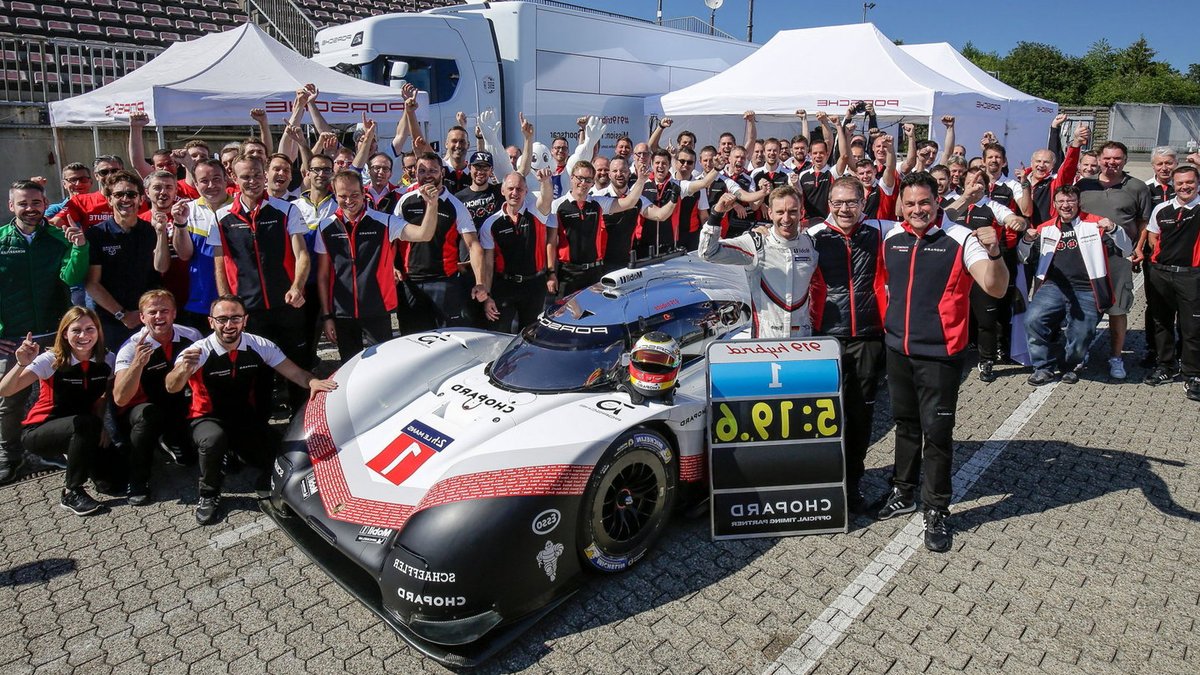
A Porsche 919 Hybrid Evo still holds the Nürburgring’s outright lap record eight years after its run. The 5:19.546 time from June 2018 remains unmatched, with the next fastest prototype, the electric Volkswagen ID.R, nearly a full minute slower at 6:05.336. This margin shows how little the prototype category has evolved since the hybrid racer’s dominance. The Porsche 919’s advantage stems from its extreme engineering. Built from Porsche’s Le Mans-winning LMP1 racer, it generates 1,144 horsepower and so much downforce that it risks damaging the track. Even purpose-built electric racers like the ID.R, which posted a 7:57.144 lap in 2018, couldn’t bridge the gap. For road-legal cars, the Mercedes-AMG One sets the benchmark in combustion super sports cars.
Its 6:29.090 lap from September 2024 isn’t just the fastest in its class—it’s the fastest production car ever around the Nürburgring. The hypercar’s 1,049 horsepower comes from an adapted Formula 1 hybrid powertrain, and its nearly 10-second lead over the next-best time reflects both its power and the lack of competition in its category.
The electric super sports car record belongs to the Yangwang U9 Xtreme, which set 6:59.157 in August 2025. The quad-motor Chinese hypercar, with 2,977 horsepower, also holds the unofficial title for the fastest production car in the world after reaching 308 mph earlier that year. Its Nürburgring lap beat the Rimac Nevera’s previous record by around six seconds, solidifying its position as the current leader in electric speed.
In the sports car category, the Porsche 911 GT2 RS with Manthey Performance Kit holds the record at 6:43.300. Though the Manthey kit is a significant modification, Porsche’s approval allows it to compete in the production class. The 991 GT2 RS’s 690 horsepower and the Manthey upgrades—including lightweight components and track-focused suspension—make it the fastest in its class by a wide margin.
Even SUVs have their own class at the Nürburgring, where the Audi RS Q8 Performance leads with a 7:36.698 lap. Despite weighing over two tonnes and producing 631 horsepower, it uses advanced tech like torque-shuffling differentials and carbon ceramic brakes to stay competitive. Its time is nearly 20 seconds faster than the next-best combustion SUV, the BMW M8 Competition.
The electric SUV record belongs to the Xiaomi YU7 GT with its Track Package. Its 7:22.755 lap from April 2026 makes it not only the fastest electric SUV but also the fastest SUV overall. Built on the same platform as the 1,527-horsepower SU7 Ultra saloon, the YU7 GT delivers 989 horsepower and track-focused upgrades. Xiaomi, which entered the car market in late 2023, has hinted at a European launch, though the YU7 GT remains exclusive to China for now.
The Porsche Panamera Turbo S E-Hybrid leads the executive combustion class with a 7:24.172 lap. Despite weighing over 2.4 tonnes, its 771-horsepower plug-in hybrid system and active ride controls keep it competitive. It beats the old Mercedes-AMG GT 63 S 4-Door by nearly 4 seconds, demonstrating Porsche’s ability to balance weight and performance in larger models.
In the electric executive class, the Porsche Taycan Turbo GT with Manthey Kit holds the record at 6:55.533. The kit includes 740 kilograms of downforce and an enhanced Attack Mode pushing power to 979 horsepower, reclaiming the title in 2025 after the Xiaomi SU7 Ultra briefly held it. The Taycan’s lap is nearly 10 seconds faster than the SU7 Ultra’s 7:04.957, securing Porsche’s dominance in this category.
Related Post: New electric and hybrid premium cars showcased at UK fleet
For mid-range cars, the BMW M4 CSL reigns supreme with a 7:18.137 lap. The 543-horsepower coupe, based on the M3/M4 platform, benefits from a weight-reduction program and aggressive aerodynamics. Its time is nearly 4 seconds faster than the M4 CS, its closest rival. Audi and Mercedes-AMG have not fielded competitive entries in this class, leaving BMW as the clear leader.
In compact cars, the BMW M2 CS holds the combustion record at 7:25.534. With 523 horsepower and a 30-kilogram weight reduction over the standard M2, it now laps the Nürburgring faster than a Ferrari Enzo did in the 2000s. Audi’s RS3 Competition Limited, while more powerful in some configurations, remains over 130 horsepower down, ensuring BMW’s dominance for the foreseeable future.
The electric compact car record is held by the Mercedes-AMG CLA 45, with a 7:32.070 lap. The 671-horsepower model is the only car to set an official time in this category, leaving little competition. Even the Renault 5 Turbo 3E, with its 400 horsepower, is no match for the AMG’s torque-vectoring all-wheel drive. This record is likely to stand for years unless a new contender emerges.
Modified vehicles present a unique case. Now, with the same car holding the production sports car record, its classification has shifted. The Tesla Model S Plaid with Track Package, meanwhile, set the electric modified vehicle record at 7:25.231 in 2023.
Its ultra-sticky tires and carbon ceramic brakes were not road-legal in Europe at the time, which explains its current classification. The Nürburgring also tracks autonomous driving records, where the Xiaomi YU7 GT with Track Package set the first timed lap at 10:29.483 in June 2026. The time is nearly 3 minutes slower than its human-driven lap, showing the gap between autonomous systems and skilled drivers.
For now, this remains the only autonomous record on the books. The front-wheel drive record belongs to the Volkswagen Golf GTI Edition 50, which set 7:44.523 in 2026. The 321-horsepower hot hatch ended years of competition between Volkswagen, Renault, and Honda, as the latter two brands have exited the European combustion hot hatch market. This record is unlikely to face serious challenges unless a new contender enters the fray.
The Nürburgring’s racing heritage is reflected in its oldest record: the 6:25.910 lap set by Stefan Bellof in 1983. Driving a Porsche 956 Group C racer, Bellof’s time remains the fastest in a competitive race setting. The Nordschleife’s original purpose as a racetrack, rather than a proving ground, ensures this record stands as a benchmark for true racing performance.
Nürburgring’s Specialized Lap Records
The Nürburgring’s record books extend beyond standard production categories, with specialized classes recognizing unique vehicle types. In the modified vehicles (combustion) category, a Porsche 911 GT2 RS Manthey Racing (991) set a time of 6:44.749 in 2018. This record was initially classified separately because the Manthey upgrades were not yet an official Porsche package, though they later became eligible for production records.


