
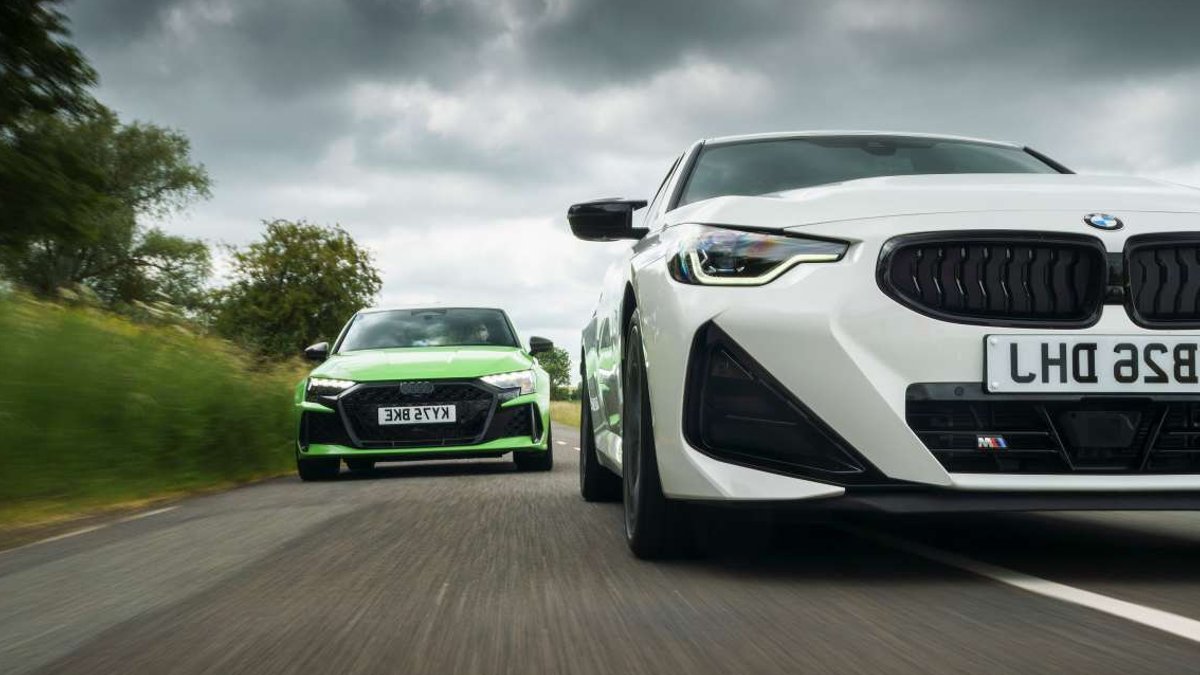
Audi’s RS3 and BMW’s M240i are the latest contenders in the hot hatch arena, offering 400bhp of power for prices that have risen dramatically over the last decade. Porsche’s 911 is now well over £100,000, and mid-engined supercars start at over £200,000, leaving buyers to look for value in the compact class. The M240i xDrive coupe enters this bracket at £50,215 with a 387bhp straight-six and a 4.3-second sprint to 62mph, undercutting the RS3 by a significant margin.
The two cars present a stark visual contrast. The RS3 wears its attitude on its exterior with blistered arches, a gaping grille, and blinding Kyalami Green paintwork. By comparison, the M240i looks a little awkward, with angles and line-work that betray its second-string status beneath the BMW M2. Inside the BMW, the curved display looks modern, though vital controls are hidden behind pixels. The Oyster leather seats offer GT vibes, while the carbonfibre trim clashes with a grotesquely overinflated steering wheel.
Related: The best V8 cars ever from Ferraris to TVRs
Step into the Audi, and the difference is immediate. The optional bucket seats (£2,500) are supportive, but the cabin lacks the theatre of its price tag. The steering wheel has two red buttons for aggressive driving modes, but otherwise, the interior is relatively standard A3 fare. The RS3’s 2.5-litre five-cylinder engine, however, guffs into life with a distinct naughtiness and anger that the BMW’s six-cylinder cannot match.
Performance and handling trends
The B58 six in the M240i benefits from a 48-volt mild-hybrid system, pushing power to 387bhp and 398lb ft of torque. The peak torque arrives at 1900rpm, 350rpm earlier than the RS3’s 394bhp. The sacrifice is a 1755kg kerb weight, 190kg more than the Audi. The eight-speed torque-converter ’box is responsive, but the RS3’s seven-speed dual-clutch unit feels slightly sharper.
On the road, the RS3’s optional adaptive damping is beautifully balanced, ironing out B-road imperfections without a harsh ride. Its all-wheel-drive system can send up to 50 per cent of power to the rear axle, using the RS Torque Splitter differential to whip the tail around. The Audi’s Pirelli P Zero Rs front tyres claw into the road with fervour, providing raw mechanical grip that the BMW’s Goodyear Eagles cannot match. The RS3’s steering, however, lacks weight and feel, even in its most aggressive mode.
Related: Modern cars aren’t actually getting worse
For drivers who prioritize natural balance and predictability, the M240i offers a more intuitive experience. Its steering feels nicer and more natural, and the rear-biased xDrive system only sends power to the front wheels when needed. The BMW’s powerband is linear and measured, revving more enthusiastically out to its red line, though it lacks the crescendo of the five-cylinder engine. It is not as fast or precise as the Audi, but its balletic, finger-tippy driving style is rewarding in its own right.
When pushing harder on a challenging road, the RS3’s superior chassis hardware and aggressive rubber become apparent. The M240i starts to feel disconnected and loses fidelity at high speeds, while the Audi only gets sharper. The RS3 is an infallible point-to-point weapon, but the M240i xDrive can feel sweeter and more approachable in daily driving. Ultimately, the M240i stands out as extraordinary value, giving buyers a compelling reason to pause before spending an extra £10,000 or more on exotic hardware.


