
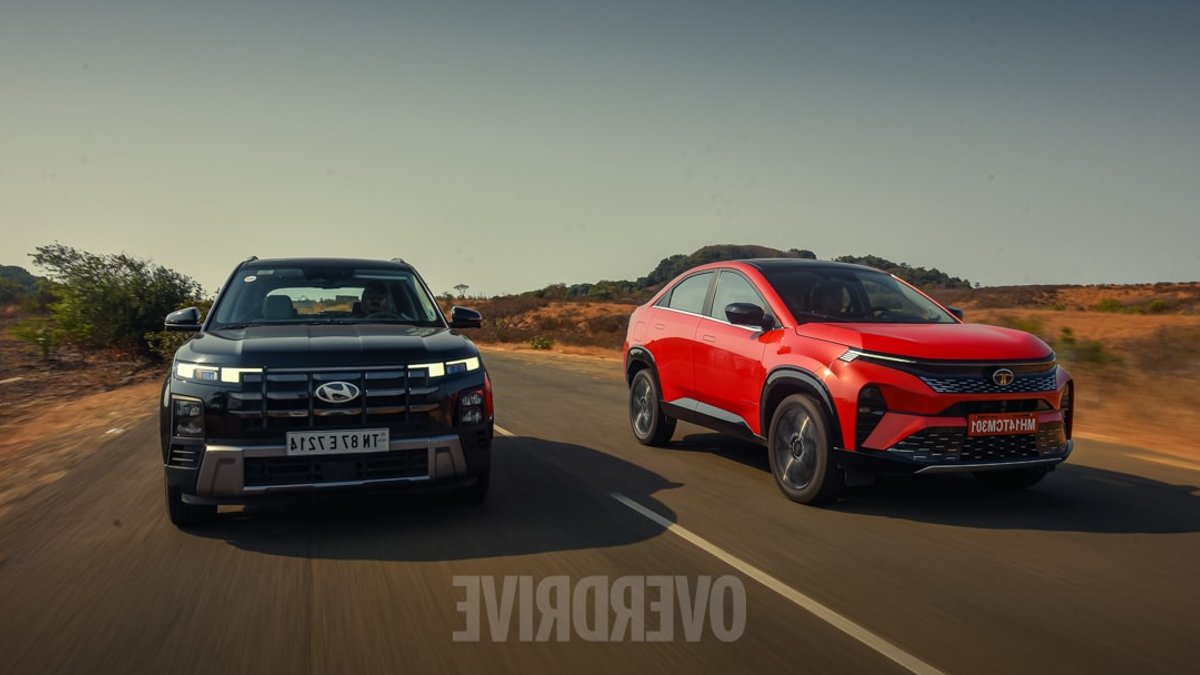
The 2025 Tata Curvv and Hyundai Creta aim at the same buyers but follow different approaches. One emphasizes bold styling, while the other focuses on polished practicality. Both include diesel engines under ₹25 lakh, a segment losing ground in India’s SUV market.
Design: Coupe-SUV vs. conventional shape
The Curvv introduces a coupe-like silhouette in this price range. Its sloping roofline and aggressive front grille attract attention, though some angles appear bulky. The Creta retains a familiar boxy SUV shape, favoring space over visual drama.
The Creta measures longer, while the Curvv is wider. Both feature sharp LED lighting and large grilles, but the Curvv’s design feels more exaggerated. The Creta’s upright stance and flat surfaces emphasize functionality, though its older bodywork clashes with newer angular details.
At the rear, the Curvv’s notchback design stands out. The Creta’s flat tailgate is clean but less memorable. The Curvv’s 500-liter boot is deeper and squarer than the Creta’s 433-liter space, and a powered liftgate adds convenience. The Creta’s flatter loading lip helps with taller items.
Interiors: Luxury vs. familiarity
The Curvv’s cabin feels more upscale at first glance. Burgundy upholstery, glossy black trim, and varied textures create a richer atmosphere. The Creta’s beige-and-grey interior is subdued, with a horizontal layout that enhances perceived space. Both include ambient lighting, though the Curvv’s version appears more refined.
Related: Yokohama launches new tyres for SUVs
Material quality presents a mixed picture. Neither SUV offers soft-touch surfaces beyond armrests, a disappointment at this price point. Hyundai’s recent update removed some premium finishes, reducing the gap with Tata. Still, the Creta’s fit and finish are tighter, with smoother panel gaps and better-damped buttons. The Curvv’s touch-sensitive controls feel less intuitive than the Creta’s tactile switches.
Space advantages go to the Creta. Its wider cabin and larger windows create a more open feel. Front passengers enjoy more legroom, and the center console provides bigger storage. The Curvv’s 12.3-inch touchscreen is larger and more responsive than the Creta’s 10.25-inch unit, with seamless wireless phone integration. However, the Hyundai’s driver display is easier to read, featuring clearer fonts and dials.
Rear-seat comfort reveals trade-offs. The Curvv’s bench offers better thigh support, but headroom is limited—taller passengers will prefer the Creta’s extra 50mm of wheelbase. Both include rear USB chargers, but the Creta’s layout is more practical.
Driving: Diesel power and real-world feel
The Curvv and Creta share a 1.5-liter turbo-diesel engine. The Curvv’s motor produces 118PS and 260Nm, slightly more than the Creta’s 115PS and 250Nm. Despite this, both reach 0-100kmph in 12.9 seconds. The Curvv’s seven-speed DCT and the Creta’s six-speed torque converter balance performance.
The Creta feels more refined on the road. Its cabin is quieter, with fewer vibrations. The engine responds quicker to throttle inputs, offering a wider power band for city traffic and highway cruising. The Curvv’s gearbox, though a DCT, is tuned conservatively. Downshifts lag during overtakes, and it often defaults to higher gears, reducing momentum. Tata’s default Sport mode helps, but it suits aggressive driving better than daily use.
Related: Honda Activa e is Indias priciest escoot
Fuel efficiency is higher in the Curvv. Real-world testing showed 15.84kmpl, compared to the Creta’s 14.37kmpl. The seventh gear provides an advantage on highways, where the difference grows.
Handling leans toward the Curvv. Its lighter steering and better body control make it more engaging on winding roads. The Creta’s heavier steering inspires confidence at high speeds but tends to drift wider on expressway curves. Comfort, however, favors the Creta. Its 17-inch wheels absorb rough patches better than the Curvv’s larger wheels, which transmit more judder on broken roads. Braking is strong in both, though the Creta stops more effectively in emergencies.
The Curvv costs ₹1.1 lakh less in Mumbai, priced at ₹23.24 lakh on-road versus the Creta’s ₹24.34 lakh. For the difference, buyers gain a more distinctive design and better fuel efficiency. Those who value standing out will find the Curvv appealing.
The Creta excels in areas that matter for most families. Its roomier cabin, smoother ride, and more refined drivetrain make daily use effortless. It may lack flash, but it delivers where it counts—space and comfort. Buyers who prioritize substance over style will find the Creta a strong choice.
The decision depends on individual priorities. The Curvv suits those wanting to make a statement. The Creta suits those needing a dependable vehicle for everyday use.


