
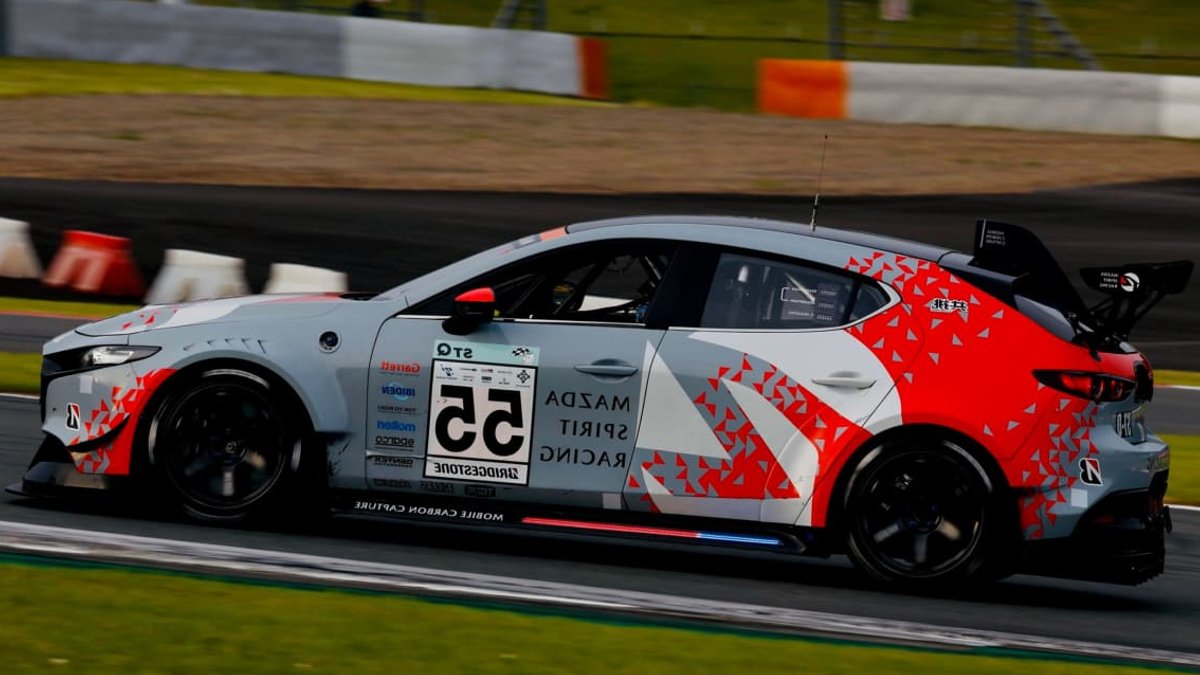
Mazda is currently testing a carbon capture system designed to reduce emissions from internal combustion engines. The hardware isn’t installed inside the engine bay but sits externally on the vehicle to trap carbon dioxide after it leaves the exhaust. This approach, known as Mazda Mobile Carbon Capture, was first shown to the public at the Japan Mobility Show last year. The prototype is a race-spec Mazda 3, labeled the Mazda Spirit Racing 3 Future Concept. The goal is to prove that internal combustion can remain relevant even as the industry shifts toward electrification.
Performance in the Fuji 24 Hours
The testing takes place in Japan’s multi-class Super Taikyu series, specifically during the Fuji 24 hours race. This venue allows engineers to monitor the system under sustained, high-load conditions that mirror real-world usage but at an accelerated pace. Earlier tests without a desorption mechanism managed to capture only 84g of CO2. That figure was modest, but it confirmed the basic concept worked. The team then integrated a desorption system to improve efficiency.
The results jumped significantly, with the car capturing 804g of CO2. That represents a 9.6-fold increase over the previous test run. The race environment provides a consistent data stream that laboratory testing simply cannot replicate.
Read Also: Cadillac takes on BMW M5 rival
How the Technology Works
The core of the system relies on Zeolite, a material with a porous structure that absorbs exhaust emissions. This setup is somewhat similar to a traditional catalytic converter, yet the handling of the captured gas differs significantly. Exhaust heat is used to desorb the raw CO2 content from the material. An electric compressor then squeezes this gas into a storage tank. It’s a mechanical process that turns a waste product into a storable resource.
The Mazda 3 prototype runs on Hydrotreated Vegetable Oil rather than conventional fuel. Mazda claims this fuel lowers lifecycle CO2 emissions, which helps because the absorption and storage capacity is finite. Running a 24-hour race on a single tank of fuel is a logistical challenge, but it helps validate the system’s limits. If the system can handle the rigors of a marathon race, it might just survive the stop-and-go traffic of a daily commute.
The results during the race temporarily exceeded the targets Mazda has set for potential production cars. The next step involves further development and testing in race cars under these high-load conditions. The path from a race track prototype to a showroom vehicle is rarely smooth. Weight and packaging are the primary hurdles for any such technology. However, if the system can be refined, it could allow future models like the MX-5 to skip heavy battery packs. It might even pave the way for a rotary-powered successor to the RX-7. For now, the data from Fuji is promising, but the engineering work is far from finished.


