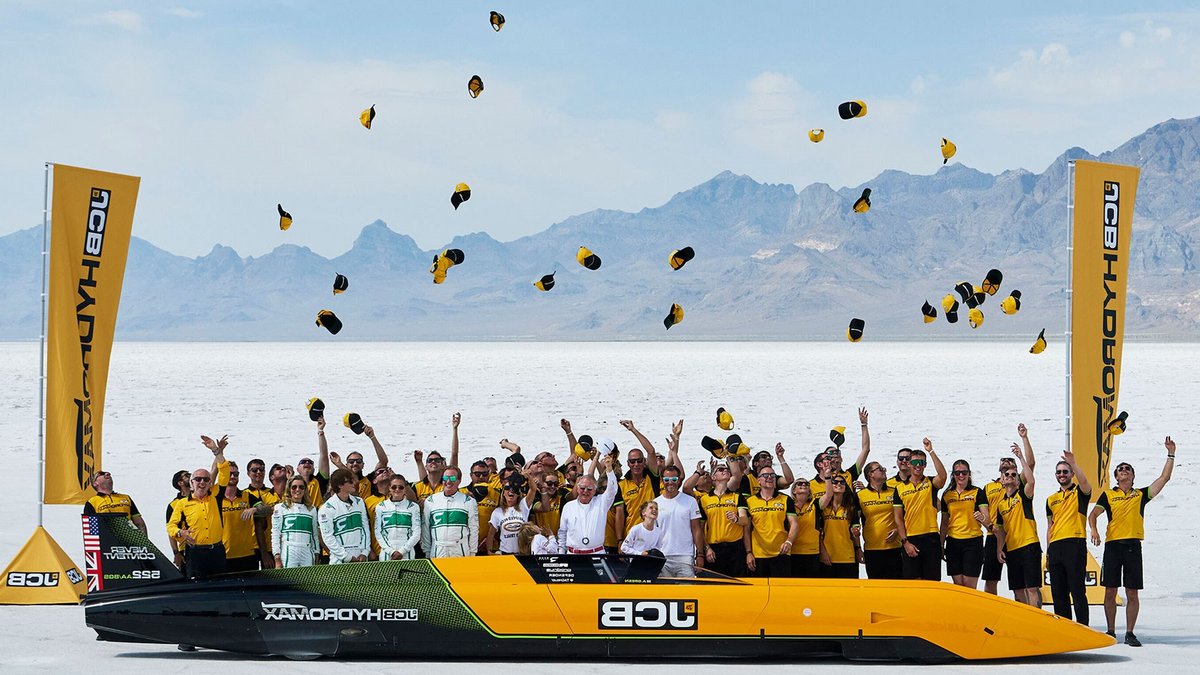
JCB has set a new land speed record of 406.320mph with its Hydromax vehicle, powered by two modified digger engines. The record was achieved at the Bonneville Salt Flats during Bonneville Speed Week, breaking the previous hydrogen internal combustion land speed record of 185.5mph set by the BMW H2R in 2004. The Hydromax, painted in a striking bright yellow, is a sign of JCB’s engineering prowess, showcasing its ability to innovate beyond its traditional focus on heavy machinery.
Breaking Records
The Hydromax, a 32-foot long, bullet-shaped vehicle, not only broke the hydrogen internal combustion record but also surpassed the speed record for all hydrogen-powered vehicles. It exceeded the 303.025mph mark set by the Venturi Buckeye Bullet 2 and shattered JCB’s own previous record of 350.092mph with the Dieselmax. The FIA-approved record was achieved by averaging two runs: 400.623mph in one direction and an impressive 412.135mph on the return, highlighting the vehicle’s consistency and performance.
The record was set by Wing Commander Andy Green OBE, a seasoned pilot who also broke the sound barrier on land in 1997 and set JCB’s Dieselmax record in 2006. His expertise was key in working through the Hydromax through the challenging conditions of the Bonneville Salt Flats.
Engineering Marvel
The Hydromax is powered by two 4.8-litre four-cylinder JCB digger engines, heavily modified with dry sump oiling systems, billet cylinder heads, and large turbochargers. Instead of a conventional cooling system, JCB engineers used 250kg of ice in two tanks to keep the engines cool during each run. This innovative cooling method was essential to prevent overheating at such extreme speeds.
The engines are positioned on their sides to lower the vehicle’s profile, enhancing aerodynamics. Two gearboxes, sandwiched with JCB digger clutches, were necessary to handle the power output of 1600bhp. The use of digger clutches was a practical solution, as no motorsport clutch could withstand the immense power generated by the engines. Despite the power figure seeming modest compared to modern electric supercars, the Hydromax’s aerodynamic efficiency made it more than sufficient for record-breaking speeds.
Sustainable Mobility
Mohammed Ben Sulayem, President of the FIA, praised the achievement, stating that it showcases the potential of hydrogen combustion for sustainable mobility. He emphasized that motorsport has always been a driver of technological progress, pushing the boundaries of what is possible. The Hydromax serves as a prime example of how innovative engineering can lead to breakthroughs in sustainable energy solutions.


