
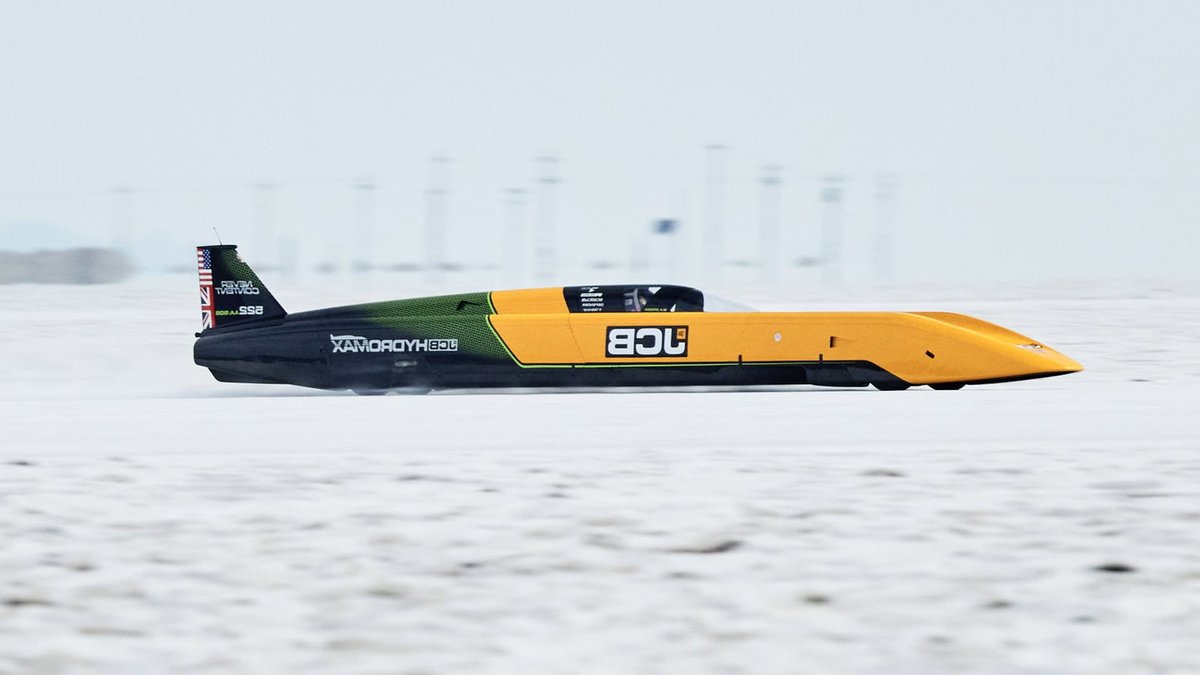
A hydrogen-powered vehicle has broken the world land speed record, hitting a two-way average of 406.320 mph on Utah’s Bonneville Salt Flats. The JCB Hydromax, developed by heavy machinery manufacturer JCB, surpassed the prior hydrogen combustion record, held since 2004 by BMW’s H2R at 185.5 mph, by over 220 mph. This also exceeds the 303.9 mph benchmark achieved by a hydrogen fuel cell electric vehicle in 2009.
The Hydromax’s breakthrough stems from its engineering: two modified 4.8-litre turbocharged four-cylinder engines, adapted from JCB’s existing hydrogen-powered excavators, delivering 1,600 horsepower and 2,600 lb-ft of torque. Its design follows the Dieselmax, which JCB used to set a diesel land speed record in 2006, a record that remains unbroken.
This record demonstrates hydrogen’s potential as a viable zero-emission power source. JCB chairman Anthony Bamford noted that the Hydromax’s engines are already in commercial use, proving hydrogen’s immediate applicability for high-performance needs. The achievement also highlights the performance gap between hydrogen combustion and fuel cell technology, as the Hydromax’s speed surpasses the 303.9 mph set by the Buckeye Bullet 2 in 2009 by nearly 100 mph.
For engineers and speed enthusiasts, the record marks a significant development. Land speed attempts have declined in recent years due to funding challenges, but the Hydromax’s success may revive interest in alternative-fuel records. The car’s stability at such speeds suggests future attempts could push hydrogen even further, though surpassing 406 mph will demand substantial technological and financial resources most teams cannot currently provide.
Whether other manufacturers will adopt this technology remains uncertain. JCB’s Dieselmax set a 350 mph diesel record in 2006, a mark that stood for two decades. The Hydromax’s 406 mph may face a similar lack of competition, but its existence forces a critical question: if hydrogen can achieve this with production-based engines, what other advancements are possible? The focus may shift from speed alone to how quickly this technology moves from specialized applications to everyday use.


